
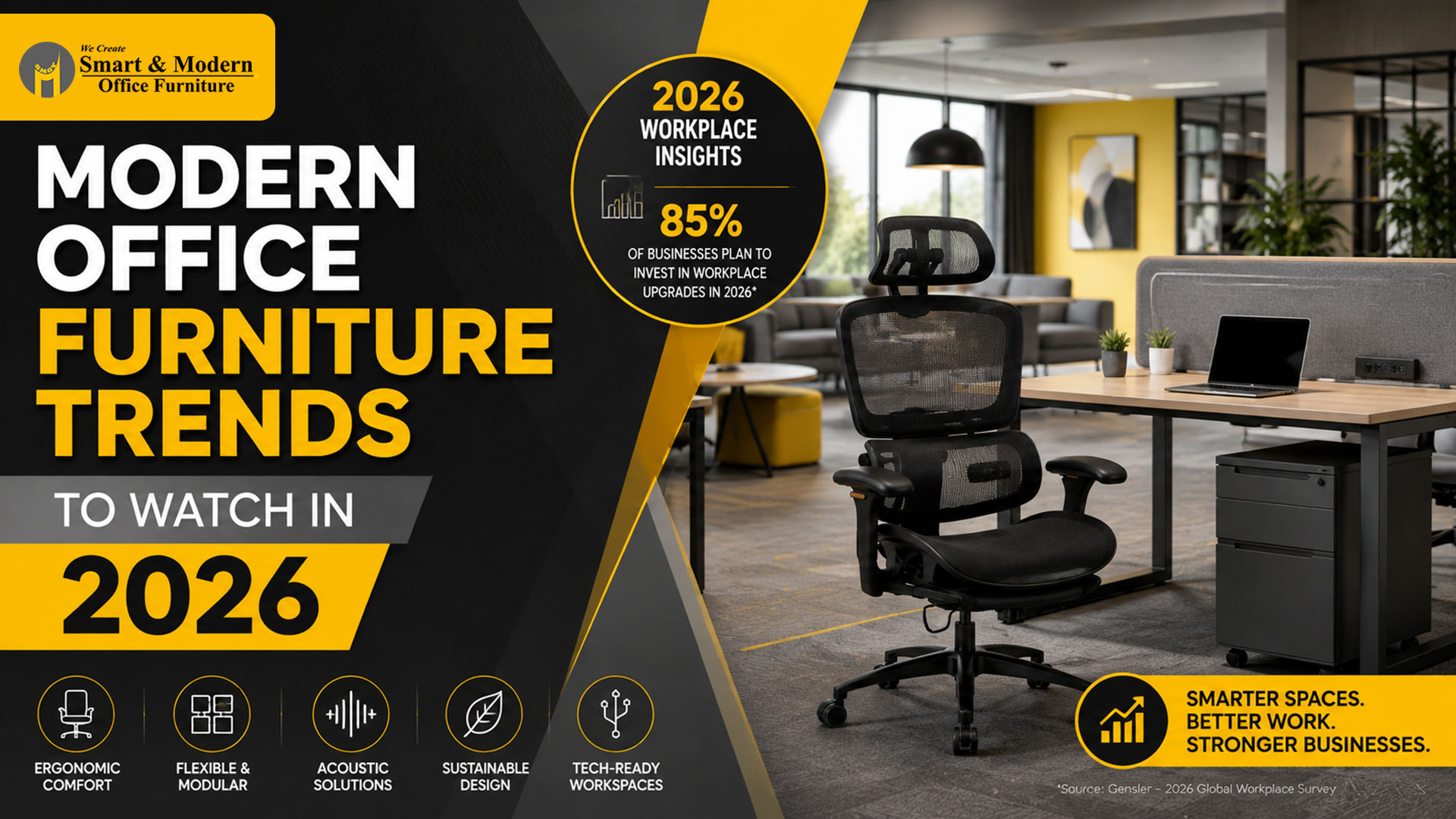
Modern Office Furniture Trends to Watch in 2026
-
By Smart Modern
- Posted on
- 0 comments
Office furniture is changing along with the way people work. In 2026, businesses are looking beyond desks and chairs that simply fill a room. Modern workplaces are increasingly being designed around flexibility, employee comfort, collaboration, technology, and efficient use of space.
Research from Gensler’s 2026 Global Workplace Survey highlights the growing importance of flexible furniture, manageable noise, technology, spaces for focused work, and areas to relax and recharge.
So, what should businesses consider when planning a modern office this year?
1. Flexible and Modular Office Furniture
One of the biggest trends in 2026 is flexibility.
Instead of designing an office around one fixed arrangement, companies are choosing modular workstations, movable tables, mobile partitions, and flexible seating that can adapt to different activities.
A meeting room may need to support a presentation in the morning and collaborative work in the afternoon. Modular furniture makes these changes easier without requiring a complete office redesign.
This approach can also help businesses make better use of their available floor space.
2. Ergonomic Office Furniture
Employee comfort has become a major consideration when selecting office furniture.
Ergonomic chairs with adjustable lumbar support, armrests, seat height, and back support are becoming standard choices for modern workspaces. Height-adjustable desks are also gaining attention because they allow employees to alternate between sitting and standing.
OSHA recommends arranging desks, monitors, chairs, and other workstation components to support neutral working positions and reduce awkward postures.
For businesses, investing in ergonomic office furniture isn’t simply about appearance. It can contribute to a more comfortable and practical working environment.
3. Workstations Designed for Hybrid Work
Hybrid work continues to influence office layouts in 2026.
Companies don’t necessarily need rows of permanently assigned desks for every employee. Instead, shared workstations, touchdown areas, hot desks, lockers, and flexible seating zones can provide employees with different options depending on how they work.
This makes the office more adaptable while helping businesses use their available space more efficiently.
4. Acoustic Furniture and Privacy Solutions
Open-plan offices can encourage communication, but excessive noise can make concentration difficult.
This is why acoustic solutions are becoming increasingly important. Acoustic panels, privacy screens, high-back seating, meeting pods, and semi-private work areas can help create quieter zones within an open office.
Rather than completely separating employees, the goal is to create a balance between collaboration and concentration.
5. Biophilic and Natural Design
Another noticeable trend is the growing use of natural-looking materials and greenery.
Wood finishes, indoor plants, natural textures, earthy colours, and access to daylight can make offices feel warmer and less institutional.
In the UAE, where businesses often want a sophisticated corporate appearance while maintaining a welcoming atmosphere, combining natural materials with modern office furniture can create an especially effective design.
6. Technology-Ready Office Furniture
Technology is now an essential part of almost every workplace.
Modern desks and conference tables are increasingly designed with integrated power outlets, USB charging, cable management, monitor arms, and connectivity solutions.
The objective isn’t to add technology simply because it is available. Furniture should make everyday technology easier to use while keeping the workspace clean and organised.
7. Furniture That Supports Different Work Modes
The modern office isn’t only a place for individual desk work.
Employees may need spaces for focused work, meetings, brainstorming, informal discussions, learning, or simply taking a short break. Gensler’s 2026 research similarly identifies focused work, collaboration, learning, and opportunities to recharge as important workplace experiences.
This is encouraging companies to create different furniture zones rather than relying on one desk type throughout the entire office.
8. Sustainable and Long-Lasting Furniture
Sustainability is also becoming more relevant to furniture decisions.
Businesses are increasingly considering the materials, durability, repairability, lifecycle, and long-term value of furniture rather than focusing only on its initial price.
Choosing durable furniture that can be repaired, reconfigured, or reused can reduce the need for frequent replacement and make office investments more practical over time. Current 2026 workplace guidance also highlights lifecycle cost, adaptability, maintenance, and sustainability documentation as important procurement considerations.
The Future of Office Furniture Is More Flexible
The biggest office furniture trend of 2026 isn’t one particular desk, chair, colour, or material. It is the move toward workspaces that can adapt to people and changing business needs.
A successful office may combine ergonomic workstations, executive desks, collaborative tables, acoustic solutions, comfortable breakout seating, and technology-ready furniture.
Instead of asking, “What furniture is trending?”, businesses should ask:
“What furniture will help our people work better and make better use of our space?”
That question leads to a workspace that is not only modern today but also ready for tomorrow.
