
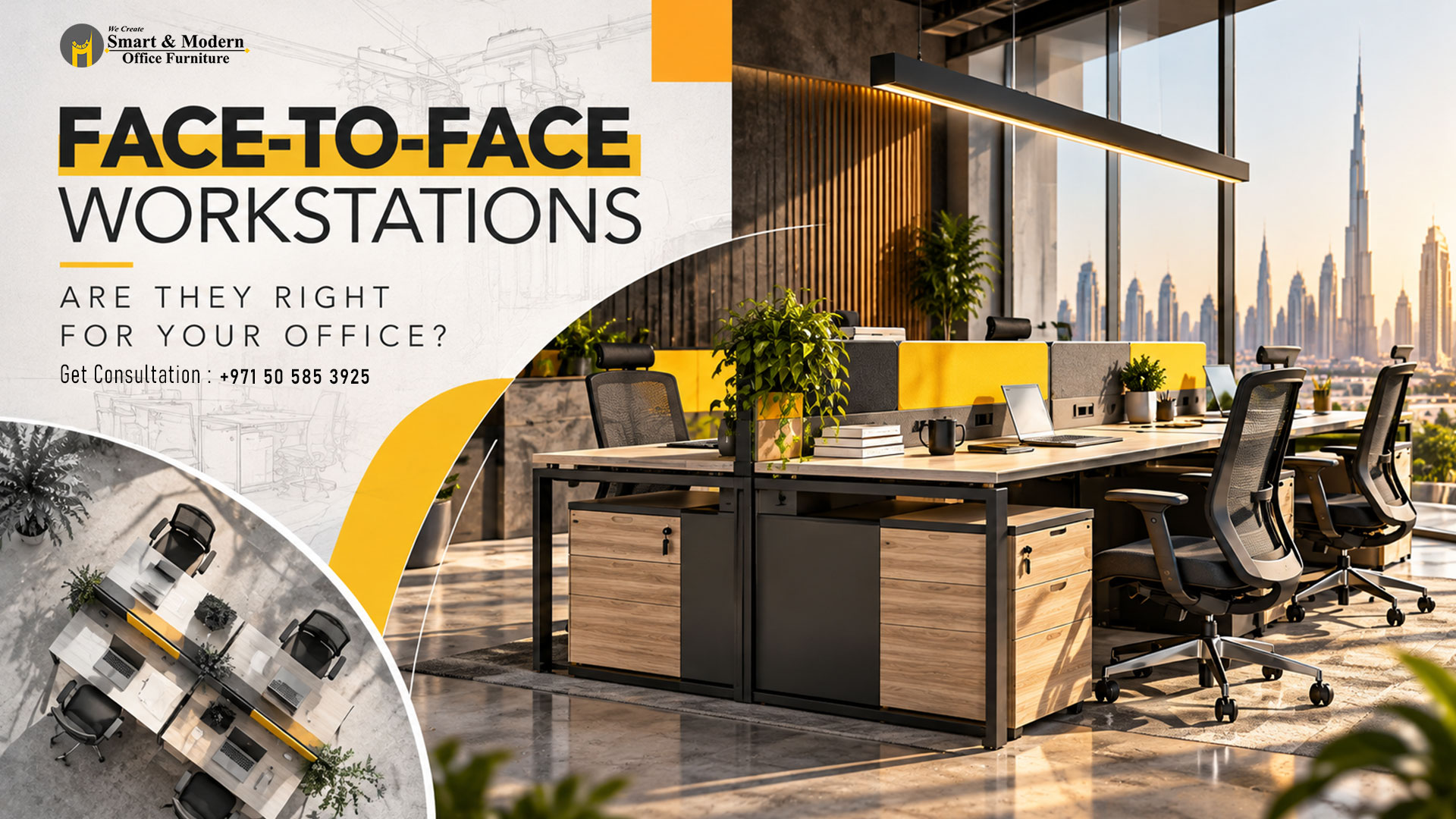
Face-to-Face Workstations: Are They Right for Your Office?
-
By Smart Modern
- Posted on
- 0 comments
Choosing the right workstation layout can have a major impact on how efficiently your office uses space, how teams communicate, and how employees experience their daily work environment. Among the most practical options for modern workplaces are face-to-face workstations—a layout where two or more employees sit opposite each other and share a central structure, divider, or storage element.
For businesses looking for a balance between space efficiency, collaboration, organization, and professional design, face-to-face workstations can be an excellent solution.
What Are Face-to-Face Workstations?
Face-to-face workstations are office desks designed for employees to work opposite one another. They are commonly arranged in two-person, four-person, six-person, or larger clusters.
This configuration makes efficient use of floor space while creating dedicated work areas for teams. Depending on the design, workstations can include privacy panels, cable management, central storage, drawers, modesty panels, and integrated power solutions.
They are particularly suitable for businesses that need to accommodate multiple employees without making the office feel overcrowded.
Why Choose Face-to-Face Workstations?
1. Better Use of Office Space
One of the biggest advantages of face-to-face workstations is space efficiency.
Instead of placing individual desks throughout the office, multiple employees can share a structured workstation cluster. This can help businesses accommodate more employees while maintaining clear circulation paths.
For companies planning an office furniture layout in Dubai, this type of configuration can be particularly useful when floor space needs to be used efficiently.
2. Encourages Team Interaction
Employees who work closely together can communicate more easily when their workstations are positioned opposite each other.
A systematic review of workplace design research found that proximity between coworkers is associated with more frequent and longer face-to-face interactions.
This makes face-to-face workstations potentially suitable for teams that regularly exchange information, collaborate on projects, or need quick communication throughout the day.
3. Creates a More Organized Workspace
Modern office workstations can integrate storage, cable management, privacy screens and other practical features into the furniture system.
A well-planned workstation should provide sufficient desk space, legroom and appropriate positioning for monitors and other equipment. OSHA recommends workstation arrangements that support neutral working positions and adequate clearance.
The result is a cleaner and more structured workspace with fewer loose cables and unnecessary furniture pieces.
4. Supports a Professional Office Design
Face-to-face workstations are available in a wide range of materials, colours, finishes and configurations.
Businesses can choose combinations such as:
- White and wood finishes
- Grey and black
- Walnut and charcoal
- Custom laminate colours
- Acoustic privacy panels
- Glass or fabric partitions
- Integrated storage solutions
This allows the workstation design to complement the company’s brand identity and overall office interior.
Are Face-to-Face Workstations Ergonomic?
The workstation configuration itself does not automatically make a workspace ergonomic. Desk dimensions, chair quality, monitor position, keyboard placement and adjustability all matter.
OSHA recommends positioning monitors directly in front of users, maintaining adequate leg clearance and arranging workstations so employees can maintain comfortable, neutral postures.
When selecting face-to-face workstations, consider:
- Adequate desk depth
- Comfortable legroom
- Ergonomic office chairs
- Correct monitor positioning
- Suitable desk height
- Easy cable management
- Adjustable components where appropriate
- Sufficient space between workstations
A good workstation should support the person using it—not simply fit into the available floor area.
Face-to-Face vs. Individual Workstations
So, which is better?
Face-to-face workstations are generally a strong option for teams that value collaboration and efficient space utilization. Individual workstations may be preferable when employees require greater personal space, privacy, or separation.
The right choice depends on your:
- Number of employees
- Office size
- Team structure
- Privacy requirements
- Nature of work
- Storage requirements
- Future expansion plans
There is no single workstation layout that works for every business. The furniture should be planned around how people actually work and move through the office.
Who Should Consider Face-to-Face Workstations?
Face-to-face workstation systems can work particularly well for:
- Corporate offices
- IT companies
- Startups and SMEs
- Call centres
- Sales teams
- Real estate companies
- Customer service teams
- Shared offices
- Project-based teams
- Open-plan workplaces
For growing businesses, modular workstation systems can also make it easier to reconfigure the workspace as teams and requirements change.
How to Choose the Right Face-to-Face Workstation
Before purchasing, consider more than appearance.
First, measure the available floor area and identify circulation requirements. Then determine how many employees need to be accommodated and whether they require shared or individual storage.
Next, consider privacy, acoustics, power access, cable management and ergonomics.
The workstation should also leave enough space for employees to move comfortably around the office. A well-designed layout should balance workstation capacity with usable circulation and collaborative areas.
Final Thoughts
Face-to-face workstations can be an excellent choice for modern businesses looking to combine efficient space planning with collaboration and professional office design.
When properly planned, they can help create a workspace that is organized, functional and visually consistent while making efficient use of available floor space.
The key is not simply choosing a workstation—it is choosing a workstation solution designed around your people, space and business requirements.
For businesses searching for face-to-face workstations in Dubai, a customized approach can help ensure that the furniture, layout, storage and finishes work together as one complete office solution.
