
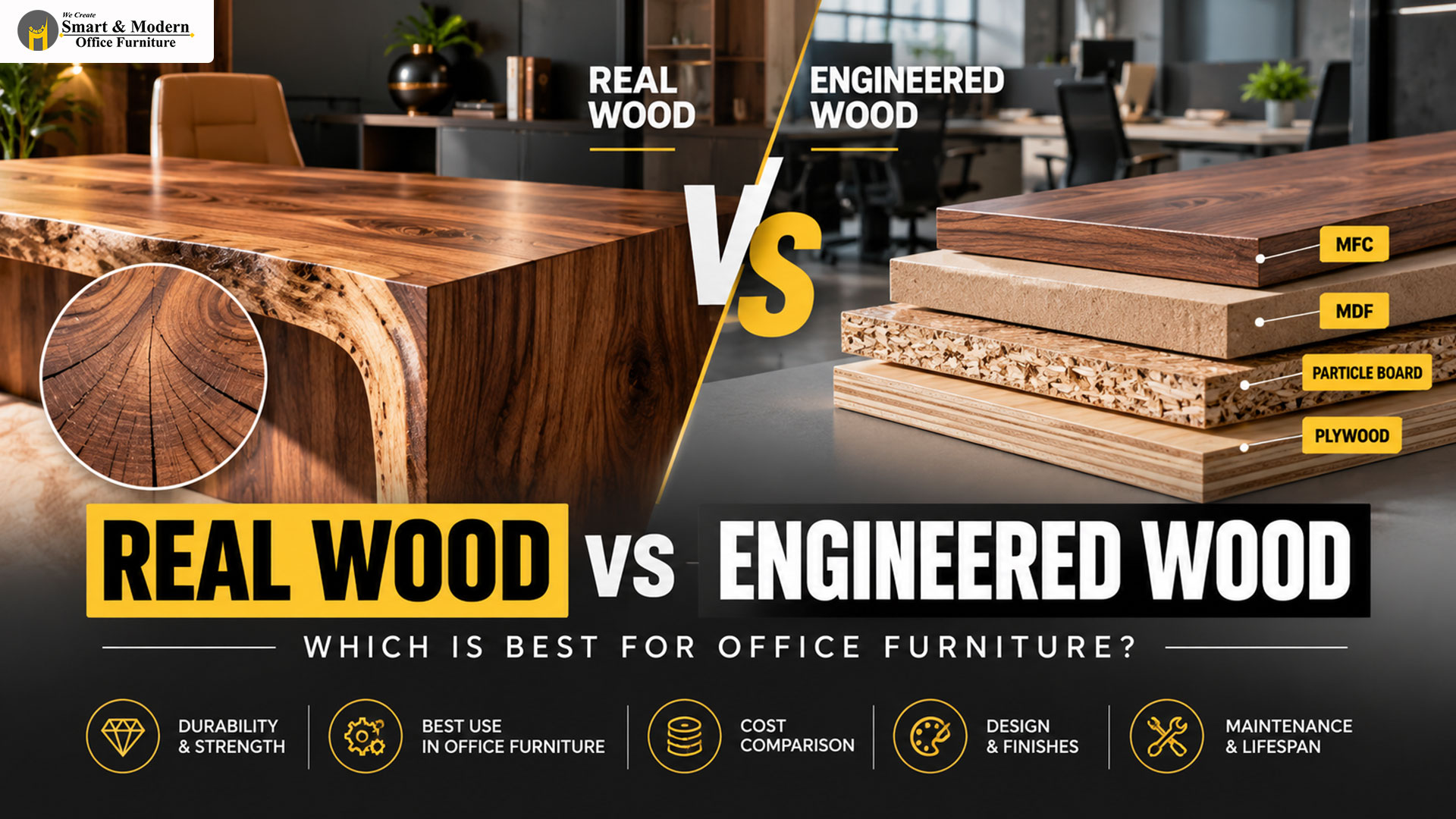
Real Wood vs Engineered Wood: Which Is Best for Office Furniture?
-
By Smart Modern
- Posted on
- 0 comments
Choosing the right material is one of the most important decisions when planning an office interior. From executive desks and meeting tables to workstations, reception counters, and storage cabinets, the material you select influences the furniture’s appearance, durability, maintenance, and overall cost.
Two popular options are solid wood and engineered wood. While solid wood offers natural grain patterns and a traditional premium appeal, engineered wood products such as MDF, MFC, and plywood provide different advantages for modern commercial furniture.
For businesses in Dubai and across the UAE, understanding these differences can help you select office furniture that suits your design preferences, daily usage, and budget.
1. What Is Real Wood Furniture?
Real wood furniture is made from natural timber obtained directly from trees. When a furniture component is made from solid wood, the timber runs throughout the piece rather than consisting of a manufactured board with a decorative surface.
Common wood species used in furniture include oak, walnut, teak, ash, and beech. Each has its own grain pattern, colour, hardness, and visual character.
Advantages of real wood
- Natural appearance: Every piece has distinctive grain patterns and colour variations.
- Long-term repairability: Many solid wood surfaces can be sanded, refinished, or repaired when appropriate.
- Premium character: Natural timber can create a sophisticated appearance in executive offices and client-facing spaces.
- Custom craftsmanship: Wood can be shaped, carved, and joined to create distinctive furniture designs.
Where is real wood suitable for office furniture?
Solid wood is particularly suitable for premium executive desks, statement meeting tables, selected furniture legs, decorative features, and bespoke furniture pieces where natural craftsmanship is a priority.
However, solid wood can expand or contract as humidity changes. Proper timber seasoning, suitable construction methods, and protective finishes are important for long-term performance.
2. What Is Engineered Wood Furniture?
Engineered wood is manufactured by bonding wood fibres, particles, veneers, or layers together to create boards with specific characteristics. It is widely used in contemporary office furniture because it can provide consistent dimensions, smooth surfaces, and a broad range of decorative finishes.
The main types include MDF, MFC, and plywood. These materials are not interchangeable; each has different structural properties and suitable applications.
MDF (Medium-Density Fibreboard)
MDF is made from wood fibres bonded with resin under heat and pressure. Its smooth, uniform surface makes it suitable for painted finishes, decorative panels, and custom furniture designs.
Best uses: Reception counters, decorative wall panels, cabinet doors, and selected desk components.
Standard MDF can swell if moisture reaches the board. Moisture-resistant grades may be appropriate for certain applications, but they are not waterproof.
MFC (Melamine-Faced Chipboard)
MFC is a particleboard panel finished with a decorative melamine surface. It is available in numerous colours, woodgrain patterns, and contemporary finishes.
Best uses: Office workstations, desk surfaces, storage cabinets, pedestals, and modular office furniture.
Commercial-grade MFC can be a practical choice for offices requiring consistent finishes across many workstations. Board quality, edge banding, hardware, and the specified product grade all affect its performance.
Plywood
Plywood is manufactured by bonding layers of wood veneer, usually with the grain direction alternating between adjacent layers. This construction can provide good strength and dimensional stability.
Best uses: Selected structural panels, cabinet components, shelves, and furniture applications where panel strength is important.
The appropriate plywood grade depends on the intended load, exposure conditions, and construction requirements.
3. Real Wood vs Engineered Wood: Key Differences
| Feature | Solid wood | Engineered wood |
|---|---|---|
| Appearance | Natural grain throughout | Smooth, laminated, painted, or veneered finishes |
| Cost | Generally higher | Varies by board type and finish |
| Design options | Natural shapes and craftsmanship | Wide range of colours and consistent finishes |
| Moisture behaviour | Expands and contracts with humidity | Depends on the board; some swell if exposed to moisture |
| Repairability | Often can be refinished | Depends on the surface and board construction |
| Best applications | Premium and statement furniture | Workstations, storage, cabinetry, and custom interiors |
Neither option is automatically better for every project. The right choice depends on the intended application, material grade, construction quality, and maintenance expectations.
4. Which Material Is Best for Different Office Furniture?
Executive desks
For a premium executive office, solid wood or a real wood veneer over a suitable engineered core can create an elegant, professional appearance.
A veneer finish uses a thin layer of genuine wood over a supporting panel. This can provide the visual character of natural wood while allowing large surfaces to be manufactured with a consistent appearance.
Office workstations
MFC is often a practical option for open-plan offices, where multiple desks need matching finishes and efficient use of the project budget.
A suitable commercial-grade board, properly finished edges, and reliable fittings are important when workstations are used every day.
Reception desks
Reception counters can combine materials to achieve both appearance and functionality. For example, an engineered wood structure may be finished with decorative laminate, wood veneer, or painted MDF panels.
Solid wood details can be added where natural texture or a premium visual feature is desired.
Storage cabinets and pedestals
MFC and MDF are commonly used in storage furniture, depending on the design and construction. Plywood may also be appropriate for selected components requiring additional structural performance.
For storage cabinets, pay attention to shelf loading, hinge quality, drawer runners, edge protection, and resistance to everyday wear.
Meeting tables
The best material depends on the table’s size, intended use, and design. Solid wood can create a distinctive centrepiece in a premium boardroom, while engineered panels with a high-quality finish can provide an attractive and practical solution for everyday meeting spaces.
Large tabletops should be designed with the material’s structural and movement characteristics in mind.
5. What Should Businesses in Dubai Consider?
When selecting office furniture in Dubai and the UAE, consider the environment in which it will be used, not just its initial appearance.
Air-conditioned interiors, changes in humidity, direct sunlight, cleaning routines, and daily usage can all affect furniture over time.
Use these practical guidelines:
- Choose furniture materials suitable for the intended indoor environment.
- Protect exposed board edges from standing water and spills.
- Avoid prolonged direct sunlight on furniture finishes.
- Select suitable board grades and protective coatings for the application.
- Check the quality of hinges, drawer runners, joints, and edge banding.
- Ask your supplier to specify the actual board material and surface finish in the quotation.
A premium-looking woodgrain finish does not necessarily mean that the entire furniture piece is made from solid timber. Ask whether the product uses solid wood, real wood veneer, melamine-faced board, or another decorative finish so you can compare quotations accurately.
6. Can Real Wood and Engineered Wood Be Combined?
Yes. Combining materials can be an effective approach to modern office furniture design.
For example, an executive desk may use a veneered engineered panel for its large tabletop, solid wood detailing for selected visible components, and a metal frame for structural support.
A reception counter could combine an MDF decorative front, an engineered wood cabinet structure, and metallic accents. A workstation system may use MFC work surfaces with metal legs and cable-management accessories.
This approach allows each material to serve a specific purpose while maintaining a cohesive design.
Conclusion
Real wood and engineered wood both offer valuable benefits for office furniture. Solid wood is an excellent option for statement pieces and designs that celebrate natural craftsmanship, while MDF, MFC, and plywood offer different advantages for workstations, storage cabinets, reception counters, and other commercial applications.
The best solution is not always to use one material throughout the entire office. Instead, choose materials according to the furniture’s function, required finish, expected usage, and budget.
At Smart & Modern Office Furniture, thoughtful material selection is an important part of creating functional and visually cohesive workspaces. Whether you are furnishing an executive office, planning a workstation layout, or developing a custom reception area, choosing the right materials can help you achieve the right balance between design and practicality.
Planning your next office project in Dubai? Explore office furniture and interior solutions at https://smartofficefurniture.ae/.
