
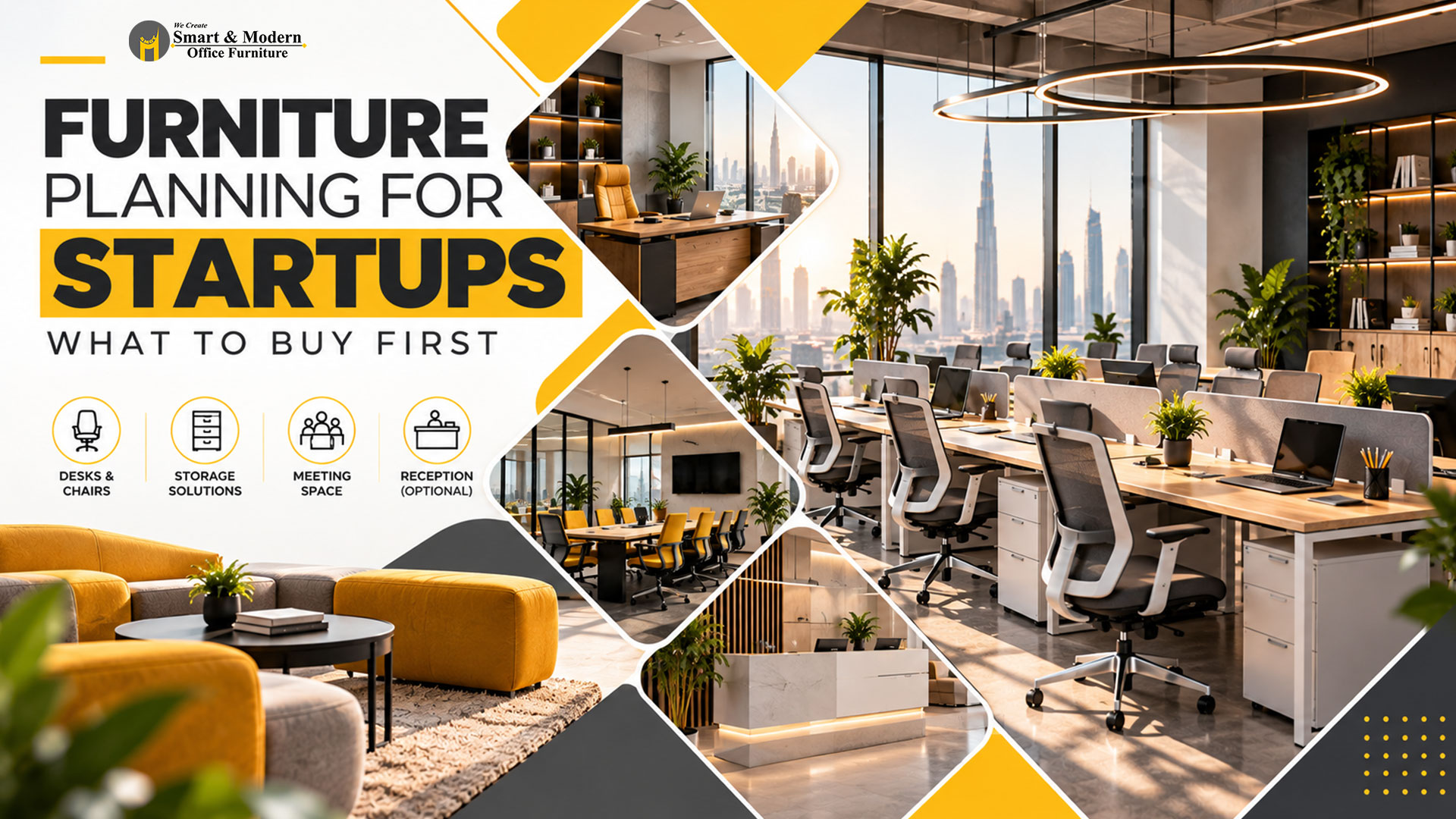
Furniture Planning for Startups: What to Buy First
-
By Smart Modern
- Posted on
- 0 comments
Starting a business comes with plenty of expenses, and setting up your first office is one of the most important investments. From desks and chairs to meeting tables and storage, choosing the right furniture can help you create a professional, comfortable, and productive workplace without spending more than necessary.
For startups in Dubai and across the UAE, the key is to prioritise essential furniture, use the available space wisely, and plan for future growth. You do not need a fully furnished corporate office on day one. You need a functional workspace that supports your team and can evolve as your business expands.
In this guide, we explain what office furniture startups should buy first, how to manage the budget, and how to plan a flexible workspace for long-term success.
1. Start with a Clear Office Furniture Plan
Before purchasing anything, understand how your team will use the office. Consider the number of employees, daily work activities, client visits, available floor space, and expected growth.
A startup with five employees may need only a few desks, ergonomic chairs, and shared storage. A growing company with 15 or 20 employees may benefit from modular workstations, a dedicated meeting area, and additional storage solutions.
Start by answering these questions:
- How many employees need permanent workstations?
- Will employees work individually or in teams?
- Do clients regularly visit the office?
- How much space is available for furniture?
- Is the company likely to hire more employees soon?
Once you understand these requirements, you can create a furniture checklist and avoid unnecessary purchases.
2. Buy Essential Office Desks and Workstations First
Desks and workstations form the foundation of any office. Every employee needs a suitable place to work, organise equipment, and complete daily tasks.
For startups with limited space, compact desks or shared cluster workstations can be practical options. They help organise multiple employees within a planned layout and can make better use of the available floor area.
When selecting office desks, consider:
- Suitable desk dimensions for computers and daily tasks
- Durable tabletop materials and a stable frame
- Integrated cable management where required
- Drawers or storage options for frequently used items
- A layout that allows comfortable movement around the office
If you expect your team to expand, consider modular workstations that can be extended or rearranged later. This can reduce the need to replace your entire setup when new employees join.
3. Invest in Comfortable Ergonomic Office Chairs
Office chairs should be a priority because employees may spend several hours working at their desks each day. A suitable chair can support a more comfortable working posture and help employees adjust their seating to their needs.
Look for ergonomic office chairs with adjustable seat height, appropriate back support, a comfortable seat, and a stable base. Breathable materials and adjustable features can also be useful for daily office use.
Before purchasing chairs, consider:
- The number of hours employees spend seated
- Adjustable seat height and back support
- Seat dimensions and comfort
- Build quality and durability
- Warranty coverage and replacement-part availability
Avoid choosing chairs based only on appearance or the lowest price. For a startup, buying suitable seating from the beginning may offer better long-term value than replacing uncomfortable chairs later.
4. Add Basic Storage to Keep the Office Organised
Storage is often overlooked when startups plan their first office. However, documents, stationery, office supplies, and equipment can quickly clutter desks if there is no dedicated place to keep them.
Start with the storage you actually need. Depending on your business, this might include mobile pedestal drawers, shared storage cabinets, or shelving units.
For a small office, shared storage can be more space-efficient than providing a large cabinet for every employee. Businesses that handle physical documents may need lockable cabinets, while digital-first teams may require less paper storage.
Choose storage furniture that fits your layout, provides easy access to frequently used items, and keeps important documents secure.
5. Choose a Practical Meeting Table
Even a small startup may need a place for team discussions, client meetings, interviews, and project reviews.
You do not necessarily need a large boardroom table. Choose a meeting table that accommodates your usual number of participants without occupying too much space.
For a compact office, a small meeting table or a flexible discussion area may be enough. Larger teams can consider conference tables with suitable cable-management features for laptops and presentation equipment.
When selecting a meeting table, consider its capacity, shape, dimensions, cable access, and how often the space will be used. A well-planned meeting area should support collaboration while leaving enough room for employees to move comfortably.
6. Purchase Reception Furniture Based on Your Business Needs
A reception area can help create a professional first impression, but it may not be the first purchase every startup needs.
If clients, suppliers, or business partners visit regularly, a compact reception desk and a few comfortable visitor chairs may be worthwhile. For businesses that operate mainly online or work from a private office with limited visitors, these items can often wait until the core workspace is ready.
When planning reception furniture, consider your brand identity, available floor space, visitor experience, and daily requirements.
The goal is to create a welcoming entrance without taking money away from essential employee workstations and seating.
7. Set a Realistic Startup Office Furniture Budget
A furniture budget should cover more than the purchase price. Delivery, installation, accessories, and future additions may also affect the total cost.
A useful starting point is to divide your budget into priorities rather than spending equally across every furniture category.
High priority: Employee desks or workstations and suitable office chairs.
Medium priority: Essential storage, a practical meeting table, and cable-management accessories.
Depending on business needs: Reception furniture, executive desks, lounge seating, decorative furniture, and additional meeting-room pieces.
The exact allocation will depend on your team size, office layout, furniture specifications, and available budget. Request an itemised quotation so you can compare materials, dimensions, quantities, installation, and warranty terms before making a decision.
For startups in Dubai, comparing complete office furniture packages with individual purchases may also help you understand the overall project cost.
8. Plan for Future Business Growth
Your first office should support your current team without making future expansion difficult.
If you expect to hire more employees, choose furniture that can adapt to changing requirements. Modular workstations, consistent desk styles, movable storage, and flexible meeting furniture can help you update the layout more easily.
Before placing an order, consider leaving room for additional workstations and checking whether matching furniture can be supplied later.
It is also worth confirming warranty terms, maintenance requirements, delivery timelines, and after-sales support. These details can make a difference when your business needs to expand or replace individual pieces.
9. Avoid Common Office Furniture Planning Mistakes
Startups can waste money by purchasing furniture before understanding their actual needs. Avoid these common mistakes:
- Buying before measuring: Measure the office and plan doorways, walkways, windows, and power points before ordering.
- Prioritising appearance over function: Choose furniture that supports daily work before investing in decorative pieces.
- Ignoring ergonomics: Select chairs and desks that suit employees and their work requirements.
- Overbuying storage: Assess what needs to be stored before choosing cabinet sizes and quantities.
- Furnishing for today only: Consider likely hiring needs and select flexible furniture where possible.
- Forgetting installation costs: Confirm delivery, assembly, and other charges in advance.
A clear furniture plan helps you spend strategically and create a workspace that is ready for business.
10. Find the Right Office Furniture Supplier in Dubai
Choosing the right supplier can simplify your startup office setup. Look for a company that understands your space, budget, furniture requirements, and future plans.
Compare product quality, customisation options, delivery schedules, installation services, and after-sales support. If your office has an unusual layout or requires specific dimensions, custom office furniture may help you use the available space more effectively.
At Smart & Modern Office Furniture, we provide office furniture solutions for businesses looking to create functional, contemporary workspaces. From office desks and cluster workstations to ergonomic chairs, meeting tables, reception furniture, and storage cabinets, you can plan the essentials around your business requirements.
Share your office floor plan and furniture requirements to explore suitable options for your team.
Conclusion
Furniture planning for startups is about making the right purchases in the right order. Begin with suitable workstations and ergonomic chairs, add essential storage and meeting furniture, and invest in reception or decorative pieces when your business needs them.
By measuring your space, setting a realistic budget, and choosing furniture that can grow with your team, you can build a professional office without unnecessary spending.
Planning your first office in Dubai? Contact Smart & Modern Office Furniture to discuss your workspace requirements and request a quotation for your startup office setup.
