
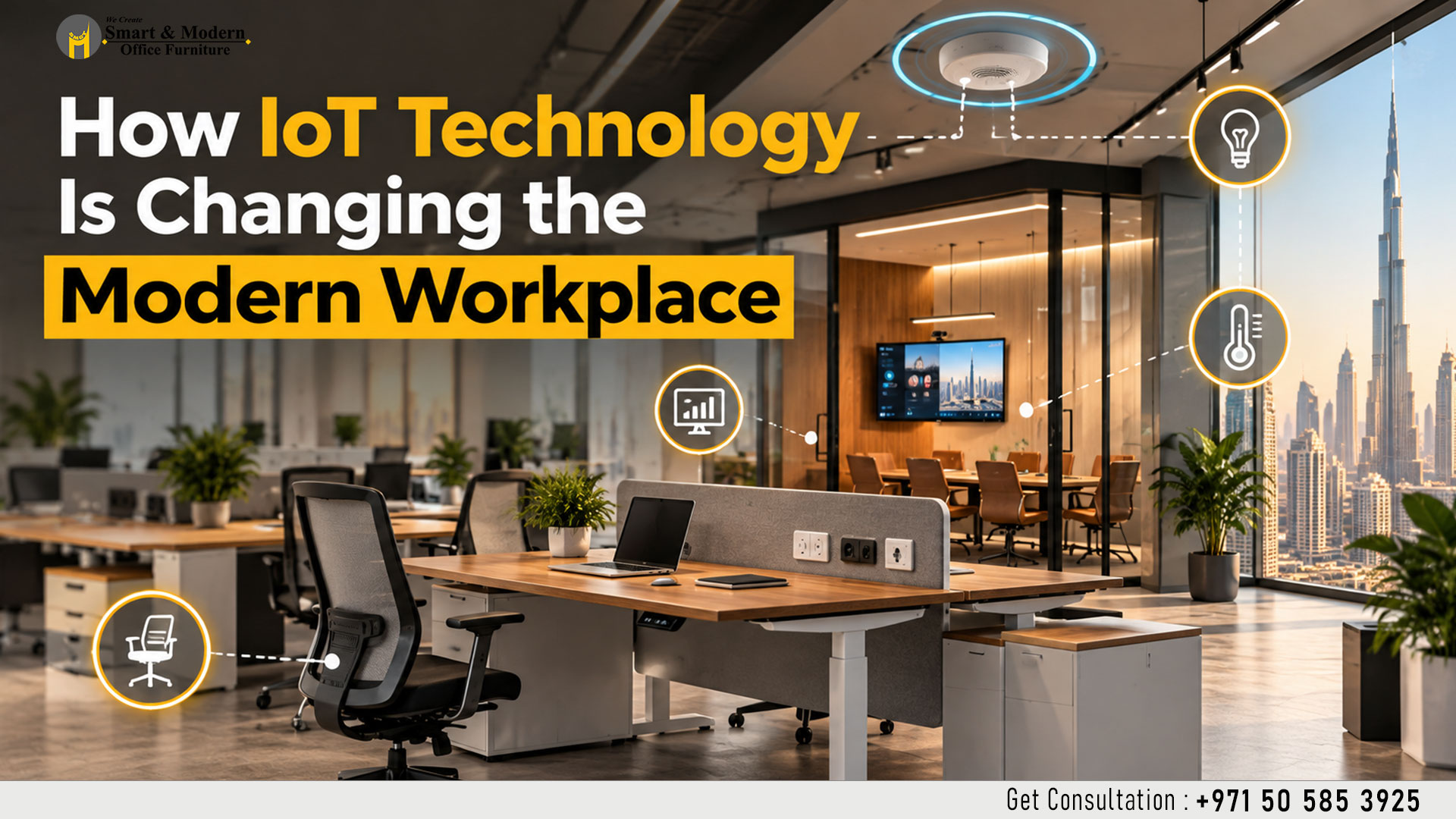
How IoT Technology Is Changing the Modern Workplace
-
By Smart Modern
- Posted on
- 0 comments
The modern workplace is evolving rapidly as businesses adopt smart technologies to improve productivity, comfort and efficiency. One of the most important developments is the Internet of Things (IoT), which connects devices, sensors and workplace systems to collect and exchange data.
From smart lighting and automated climate control to intelligent meeting rooms and occupancy sensors, IoT technology is helping businesses create more connected and efficient work environments. For companies investing in modern office furniture and workspace design in Dubai, integrating smart technology can be an important step towards building a future-ready office.
1. What Is IoT Technology in the Workplace?
The Internet of Things refers to physical devices connected to a network that can collect, share and respond to data. In an office, these devices may include occupancy sensors, smart lighting systems, connected air-conditioning controls, meeting room displays and height-adjustable desks with digital features.
By connecting these systems, businesses can monitor workplace conditions, automate routine tasks and make better decisions about how office spaces are used.
2. Smart Office Furniture Improves Everyday Comfort
Office furniture is becoming more adaptable as technology develops. Smart desks, ergonomic chairs with connected features and height-adjustable workstations can support a more comfortable and flexible working environment.
For example, a height-adjustable desk allows employees to alternate between sitting and standing throughout the day. Some smart desk models can save preferred height settings and provide reminders to change positions.
These features can help employees personalize their workstations while supporting better workspace habits. When combined with ergonomic office chairs and carefully planned workstation layouts, smart furniture can contribute to a more functional modern office.
3. Better Space Management Through Occupancy Sensors
Office space is a valuable resource, particularly for businesses operating in busy commercial areas such as Dubai. IoT occupancy sensors can help organizations understand how frequently desks, meeting rooms and shared spaces are being used.
This information can help facility managers identify underused areas, improve desk allocation and plan office layouts based on actual demand.
For example, if meeting room data shows that certain rooms are rarely occupied, a company may be able to redesign the space or introduce flexible collaboration areas. These insights can help businesses use their available office space more effectively.
4. Intelligent Meeting Rooms Support Collaboration
Modern meeting rooms increasingly combine furniture, audiovisual equipment and connected technology. Smart room systems can integrate displays, video-conferencing equipment, lighting controls and room-booking tools.
Occupancy sensors may also help identify whether a booked room is actually being used, while connected scheduling systems can make it easier for employees to find available spaces.
A well-designed meeting room should therefore consider more than just a conference table and chairs. Cable management, accessible power outlets, screen visibility, comfortable seating and suitable room layouts all contribute to a more effective meeting experience.
5. Energy Efficiency and Sustainable Offices
IoT technology can help businesses monitor and manage energy consumption. Smart lighting can adjust according to occupancy or available daylight, while connected climate-control systems can respond to room usage and temperature conditions.
These systems may reduce unnecessary energy use when properly configured. Energy monitoring can also help facility teams identify areas where efficiency improvements are possible.
Combining smart building technology with durable office furniture, efficient layouts and responsible material choices can support a more sustainable workplace strategy.
6. Improving Maintenance and Facility Management
Connected sensors can provide useful information about equipment performance and environmental conditions. In some buildings, monitoring systems can alert facility teams to unusual temperature changes, equipment faults or maintenance requirements.
This can help organizations identify certain issues earlier and plan maintenance more efficiently. However, the benefits depend on the quality of the sensors, system integration and the processes used to respond to alerts.
IoT data can also help facility managers make informed decisions about office equipment, furniture arrangements and the ongoing needs of employees.
7. Security and Data Privacy Considerations
Although IoT offers several workplace benefits, connected devices must be implemented responsibly. Every additional device can introduce security and privacy considerations.
Businesses should choose reliable systems, change default passwords, apply software updates, restrict access to sensitive data and work with qualified IT professionals. They should also establish clear policies for collecting and retaining employee-related data.
Occupancy and environmental monitoring should be designed with transparency and privacy in mind. Collecting only the data needed for a specific purpose can help organizations balance workplace efficiency with employee trust.
8. How to Prepare Your Office for IoT Technology
Businesses do not need to transform their entire office at once. A practical approach is to identify the areas where connected technology would provide the greatest value.
Start by reviewing how employees use workstations, meeting rooms and shared spaces. Next, assess existing network infrastructure, power requirements and compatibility with building systems. Select solutions that address real operational needs and can integrate with the technology already in place.
Office furniture should be considered as part of this planning process. Workstations with suitable cable management, desks with adjustable-height options, conference tables with integrated power access and ergonomic seating can help create a workspace that is ready for evolving technology.
For businesses in Dubai and across the UAE, working with an experienced office furniture supplier and workspace planning team can help align furniture selection with practical requirements, design goals and future expansion.
Conclusion
IoT technology is changing the modern workplace by helping businesses manage space, improve comfort, support collaboration and monitor energy use. When combined with thoughtful office design and suitable furniture, connected systems can create a more flexible and efficient working environment.
The most successful smart offices are not simply filled with technology. They bring together people, furniture, building systems and digital tools in a way that supports everyday work.
Investing in ergonomic office furniture, well-planned workstations and technology-ready meeting rooms can help businesses build a workplace that is functional today and adaptable for tomorrow.
Looking to create a smarter workspace? Explore modern office furniture and workspace solutions designed to support your business needs in Dubai and across the UAE.
